

Music
'Music gives a soul to the universe, wings to the mind, flight to the imagination and life to everything.’ Plato
Situated at the heart of the school, the Music Department is an integral part of school life. We aim to cater for, challenge and develop musicians of all standards and styles, from the enthusiastic beginner to the career musician.
The Key Stage Three curriculum includes our Year 7 Orchestral Instrumental Scheme, in which all pupils try out the instruments of the orchestra, before choosing one to specialise in for two terms.
Pupils from Prep to Year 8 study music for one double lesson a week, discovering and developing musical skills through performance, composition and listening activities. From Year 9, music becomes a popular optional subject, with smaller class sizes encouraging deeper analysis and understanding of music as both an academic and practical subject.
Each year we welcome visiting artists to perform and lead masterclasses for our pupils, with all concerts free for under 18s. For further information about our concert schedule, do have a look at the Music Events Brochure.
Lower School
In all years, the curriculum includes the three main components of performing, composing and listening.
YEAR 6
Year 6 pupils have two periods each week. They study the elements of music (including notation), instruments of the orchestra, programme music, gamelan and singing.
YEAR 7
Year 7 pupils have two periods each week. For one of these, in groups of three or four, they are given tuition on the violin/viola, cello/double bass, woodwind, brass and percussion, each for three weeks. In late January/early February they are then assigned to one of these instruments, on which they have tuition for the rest of the academic year. In the other lesson, they study keyboard music, scales, chords, forms/structures, and African music.
YEAR 8
Year 8 pupils have two periods each week. They study the dominant musical traditions of Western classical and African-American music, including the Blues, Caribbean music, and Soul.
YEAR 9
Music becomes an option in Year 9, and pupils have two periods each week. One of its aims is to prepare for the Edexcel course which starts in Year 10. The main elements of music are revisited, and there are particular studies of Film Music, Performance and Music Technology.
GCSE
GCSE Music: Edexcel Specification
Music is a moral law. It gives soul to the universe, wings to the mind, and life to everything... Without music, life would be an error! (Plato, Ancient Greek Philosopher)
Music has been one of the keys to human flourishing throughout history. Not only this, but embracing the breadth and rigour of GCSE Music will prepare you to understand and contribute to a dynamic and creative economy well into the Twenty First Century. Creative instincts, technical analysis, presentation skills, event management and self-expression; all are developed through the study of music and contribute decisively to your portfolio, no matter what direction you hope your future studies and career will take.
Studying GCSE music builds your confidence as a musician, opening wide the opportunity for you to participate our flagship ensembles, for instance the Chamber Choir, Big Band, Folk Group, First Orchestra and Symphonic Wind Band.
Pupils with a keen interest in both practical and academic music are encouraged to take Music. Grade 4/5 provides a useful benchmark for the standards of performance and theoretical understanding that are expected for a strong result in Year 11. The course will be most enjoyable for those who have a good understanding of music theory at the start of the course alongside a keen interest in a variety of musical genres, from musicals to classical music and pop.
Those opting for Music will play a full part in the musical life of the school, including singing in one of our many choirs.
The three modules of which the course consists are taken at the end of Year 11.
1. Listening (40%)
This is a written exam (1 hour and 45 minutes) which requires responses to extracts of music played on a CD. The extracts in Section A are based around the Areas of Study and Set Works:
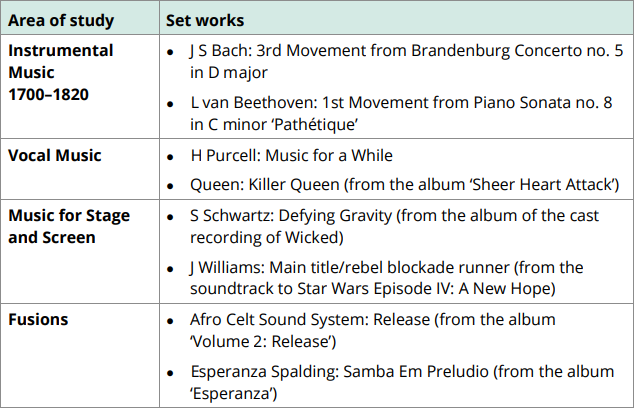 In Section B, students will be asked to compare in detail an extract of one of the set works with an extract from an unfamiliar listening piece (related to one of the set works).
Students will hear the pieces and see the scores. This question will be worth 12 marks.
The exam is externally assessed
2. Performing (30%)
Candidates must perform individually and as part of an ensemble. The performances are recorded, internally assessed and then externally moderated.
3. Composing (c.30%)
Two contrasting compositions must be submitted at the end of the course. They should be presented in written and recorded form. The compositions can be in any style and for any instrument or combination of instruments. They are internally assessed and externally moderated.
A Level
Edexcel Music 9MU0
Music is a moral law. It gives soul to the universe, wings to the mind, and life to everything... Without music, life would be an error. (Plato)
Music has been one of the keys to human flourishing throughout history. Not only this, but embracing the breadth and rigour of A level. Music will prepare you to understand and contribute to a dynamic and creative economy well into the Twenty-First Century. Creative instincts, technical analysis, critical evaluation, presentation skills, event management and self-expression; all are developed through the study of music and contribute decisively to a portfolio that is attractive to admissions tutors and employers alike.
Music A level is a rich and varied qualification that allows you to explore a wide range of musical styles, while performing and composing in musical genres according to your preference. Breadth and depth of study, both academic and practical, will allow you to develop a holistic musical understanding alongside a cultural, aesthetic and emotional awareness.
The course is suited to any musician who is keen to develop further an instrumental (or vocal) specialism and to broaden their appreciation of a range of jazz, classical and popular genres, including the increasingly popular music for game and film.
As a subject choice, A level Music coexists happily alongside any combination of other A levels and, whilst it is an excellent choice for a student wishing to study Music or other humanities subjects beyond their school years, it serves equally well as a cultural education or enrichment subject for anyone with ambitions in the sciences. We encourage anyone with a GCSE in Music or with Grade 5 theory to give it serious consideration as an option.
The co-curricular music activities on offer at LGS provide enviable opportunities for A level musicians to develop their leadership and listening skills whilst broadening their musical portfolio.
Students take three components: 01, 02 and 03
|
Content Overview |
Assessment Overview |
|
|
Performing (01) Approaches to performing |
A public performance (solo or ensemble) of one or more pieces, performed as a recital. Minimum of eight minutes performance time. Externally assessed via audio recording |
60 Marks 30% of A level
|
|
Composing (02) Approaches to composing
|
Two compositions: One Free choice composition (40 marks) One Brief Assessing Technique (20 marks) Externally assessed via audio recordings plus score |
60 Marks 30% of A level |
|
Listening and Appraising (03) Knowledge and understanding of musical elements, contexts and language. Application of knowledge through the context of six areas of study |
One written paper of 2 hours 10 minutes Audio files and extracts Four listening questions and two essay questions |
100 Marks 40% of A level |
Pupils study six Areas of Study, each with 2 - 3 set works:
|
AoS |
|
|
1 |
Vocal Music (Bach, Vaughan Williams) |
|
2 |
Instrumental Music (C. Schumann, Berlioz) |
|
3 |
Music for Film (Herrmann, Elfman) |
|
4 |
Popular Music & Jazz (Kate Bush, Beatles, Courtney Pine) |
|
5 |
Fusions (A. Shankar, Debussy) |
|
6 |
New Directions (Stravinsky, Saariaho) |
Co-Curricular
A large proportion of pupils receive individual instrumental lessons in school from our experienced and dedicated Visiting Music Teachers (VMTs). Many pupils also benefit from a selection of over 25 ensembles each week, including three orchestras, three choirs, two big bands, two large wind bands and a folk group, alongside numerous chamber ensembles. Highlights of our extensive concert schedule include:
- The biennial school musical, for which the First Orchestra provides live musical accompaniment
- The LGS Big Band at Leicester’s Little Theatre
- Interactive GCSE and A Level concerts in partnership with Bardi Symphony Orchestra with concerto opportunities for pupils
- A choral extravaganza in which our musicians accompany the LGS Choral Society and perform alongside local primary school pupils.
We are keen to share musical opportunities and performances with the local community. We raise money for local charities through concerts, take our leading instrumental ensembles on tours of local primary schools and our pupils frequently perform at events outside of school. We also invite local schools to participate in masterclasses and instrumental taster days.