




Economics
- Commitment to excellence
- To stimulate and maintain student curiosity, interest and enjoyment in Business or Economics
- To enable students to be familiar with economic and industrial knowledge, principles, skills and vocabulary, enabling students to make critical and judgmental business or micro and macroeconomic decisions
- To provide students with a learning framework which will raise their expectations and maximise their individual potential
- To enable students to understand and use investigative methods
- To enable students to work both independently and as part of a team, taking responsibility for their own learning
- To employ teaching methods and resources that allow students to have learning opportunities in Business or Economics, experiencing success and enjoyment in their work
- To enable students to apply business or micro and macroeconomic skills in the context of a wider learning environment
- To develop an awareness in students of the implications of the economy for the individual, businesses, the community, society and the environment
A Level
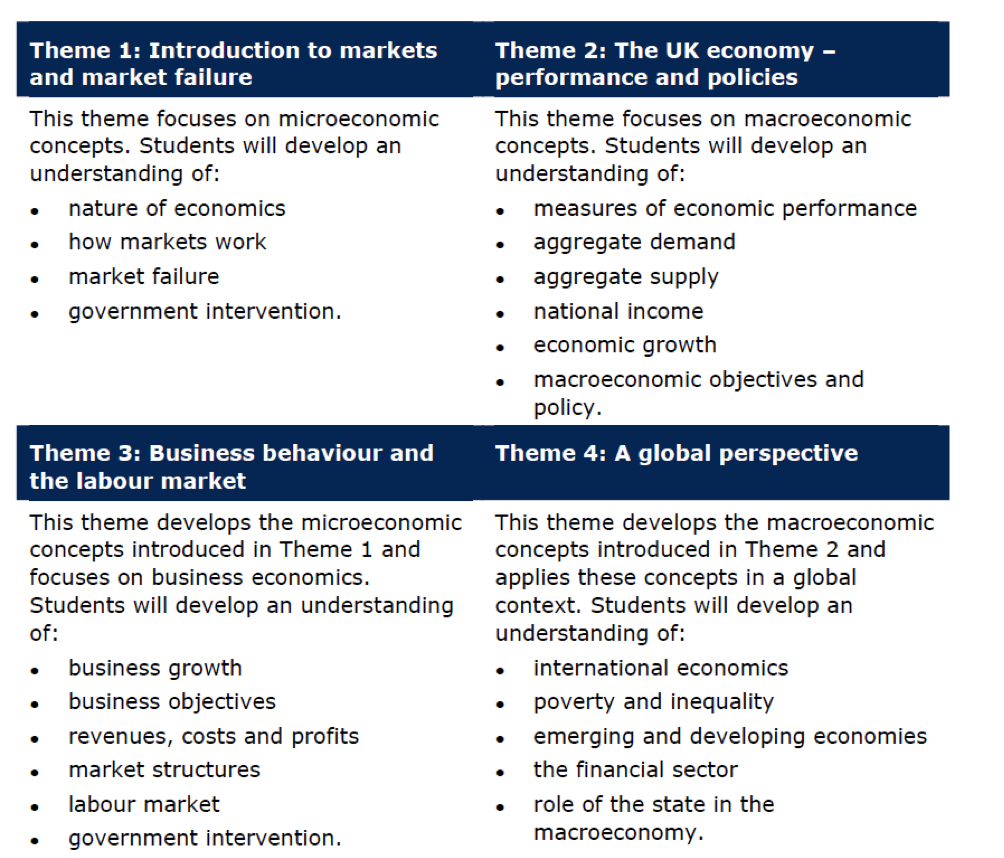
Summary of Unit Specification Structure (A-level Edexcel Economics A 9EC0):
From 2015/16, the A level is structured into four coherent themes to support teaching and learning:
- Theme 1 introduces students to markets and market failure
- Theme 2 introduces students to the UK economy, focusing on performance and policies
- Theme 3 explores business behaviour and the labour market
- Theme 4 considers a global perspective
Co-curricular
The Economics Olympiad is open to students of both Business and Economics. It's an opportunity to research a wider range of concepts at a higher level. In round one students are tested on-line. Round two involves testing at a local university with a programme of speakers and other UCAS enhancing activities.
Trips
Lower Sixth students go to London where they visit the Tax Payers' Alliance and the Financial London. In the former place, students get a practical appreciation of fiscal and supply-side policy formulation, implementation and review, it also provides them with insights into the complexities of theories studied in class. In the latter place, they attend a tour of the city and learn about financial markets, sources of finance, institutions and regulation.
Upper Sixth students visit the Mini i-Factory in Oxford. Here they have the opportunity to learn about the marketing and production strategies used by a globally competitive premium market segment automotive manufacturer, appreciating how these relate to cost and revenue diagram changes and other advanced microeconomic theories and concepts in Economics. In Business, they can relate the visit to production methods, marketing, human resource management and strategy decision making.
Other
Young Enterprise is coordinated by the department. Students set up their own business and compete against other teams locally, regionally and nationally. They learn about all the functions of a business, and formulate, implement and review their business strategies. At the end of the year they produce a report and presentation to judges from Young Enterprise. The school has won a range from prizes in the past based on our entrepreneurial flair and ability to make a lot of money. Young Enterprise is open to all students in Year 12, not just those who do Business or Economics.